Doriane Nikuze had a clear picture of how things would end. She, like many of her fellow trainees, expected that once the training was over, each of them would be handed money to start a business. Free money, nothing to pay back.
“We never thought about taking loans,” says Doriane, a refugee from Burundi who has been learning tailoring through ASHA (Action for Sustainable Health and Agriculture).
That picture changed over three days in a training room in Mahama refugee camp.
For more than seven months now, trainees, mainly young people living with disability, have been building their craft in tailoring and hairdressing through training by ASHA. Graduation is close, and ASHA wanted them to leave with more than a trade. Last week, together with Equity Foundation, ASHA ran a three-day training on financial services skills for more than 50 participants from Mahama refugee camp and the surrounding host communities.
The sessions covered creating a business plan, accessing credit and managing debt, saving and group saving models, and marketing, among other topics. The room was lively throughout, with plenty of questions and back-and-forth.
For Doriane, the biggest change was in how she thinks about money. “The training changed our mindset,” she says. “It gave us confidence and taught us that we need to earn and work for the money we use to build our businesses, rather than expect free money.” Group saving was the other lesson that stuck with her, and she sees it as a way for the trainees to grow financially together. “We thank you very much for changing our mindset, and we hope you will extend this training to our colleagues.”
Olivier Habumugisha, who is training in hairdressing, came away with a set of practical rules. The first is that a group can often do more than an individual. “The loan you can access as an individual may be far less than what you can access as a group,” he explains. The second is to use a loan only for the purpose it was requested for, even when other needs seem important. The third is to never start from nothing. “The loan should come as support to what I already have, rather than being the entire amount I depend on.” His example: if he needs Rwf 1 million, he should already have at least Rwf 100,000 of his own. “This way, the loan becomes an assistance that helps me achieve my goal.”
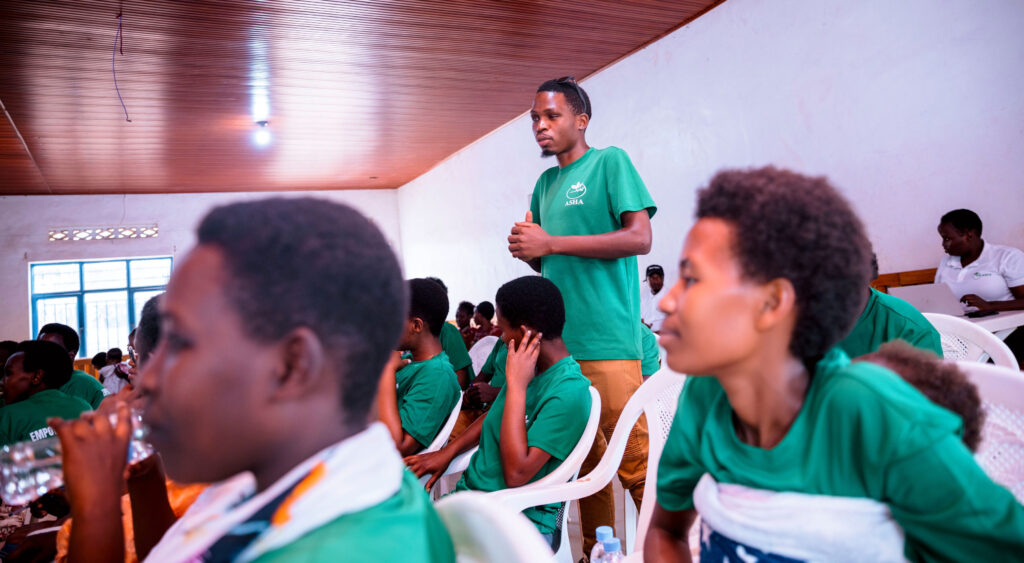
The session was marked by engaging interactions
For Innocent Kwizera of Equity Foundation, the focus was practical: helping trainees understand banking and put financial services to work. “We taught them how banking works and how they can make use of financial services to support their businesses and livelihoods.” The support won’t stop when the sessions end. Equity Foundation plans to connect the trainees with its nearest branch in Kirehe so it can keep following up and help ensure that what they learned turns into real financial benefits. “We are happy to partner with ASHA on this initiative, and we are confident that it will bear fruit,” he says. “We hope it will contribute to many young people and women here in Mahama creating jobs for themselves and building sustainable livelihoods.”
For Grace Mahoro, President and Legal Representative of ASHA, the training fills a gap that skills alone can’t. “We don’t just want our trainees to leave with a skill, we want them to leave knowing how to turn that skill into an income,” she says. “This financial training is what closes that gap.” She adds that the partnership made this possible. “Partnering with Equity Foundation allows us to give trainees something we couldn’t offer alone, the financial literacy to run a business, not just practice a trade.”
Graduation is close, and the trainees now have both a trade and a clearer idea of how to build a business around it.
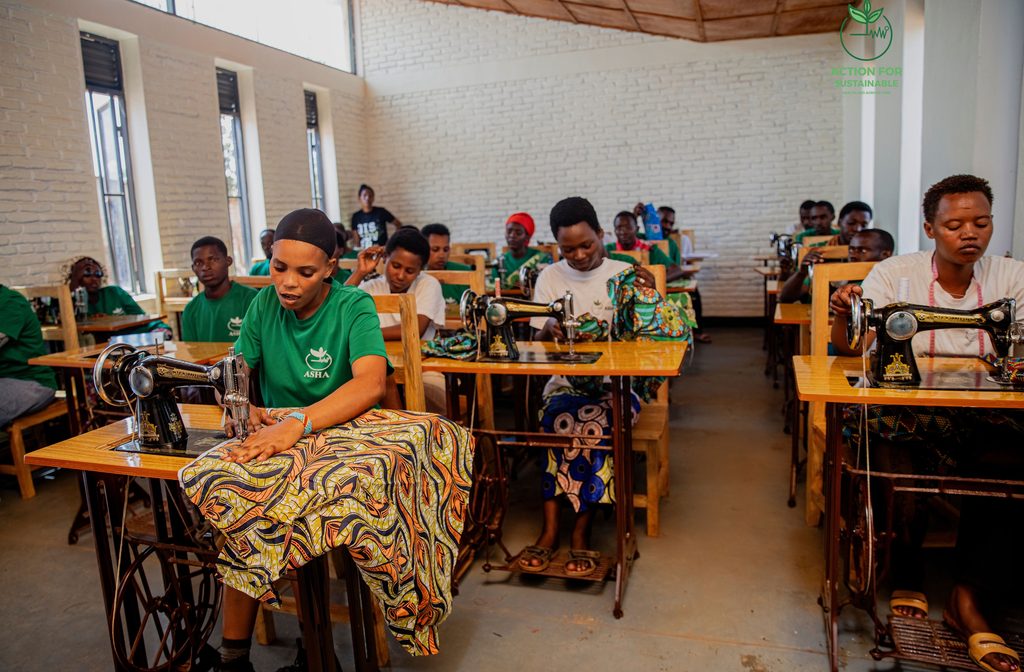
After months of training in tailoring and hairdressing, trainees learned the financial skills to run their craft as a business.